
labor
Arab and Jewish Workers Unite Against a Giant
by Assaf Adiv
While the Israeli economy adapts itself to the demands of the global market, many Jewish workers are losing the privileged status they used to enjoy over their Arab colleagues. From the viewpoint of the big companies, all are exploitable, and it is the task of both management and government to ensure that they do not organize and that they remain unaware of their rights.
Sixty drivers of an Israeli beverage company, Tempo, are struggling
for representation, better working conditions and an increase in salary.
Such a thing may not be new for labor in the West. In Israel, however,
it assumes a special importance. First, it is a struggle of Arab and
Jewish workers together. Second, it takes place apart from the national
trade-union federation (Histadrut). It is led by the new and militant
trade-union current, WAC - The Workers Advice Center.
Another important element puts the Tempo drivers in the vanguard: their employer has recently merged with a powerful partner, the Dutch beverage multinational, Heineken.
The struggle begins
Tempo, one of the biggest beverage companies in Israel, pays its drivers
between $1 and $2 per hour, instead of the Israeli minimum wage of $3.80.
A driver's pay can nevertheless reach $600 to $900 a month, but only
through various additional payments that do not count in calculating
social benefits. The company can - and does - cut off these benefits
at will. In January, Arab and Jewish Tempo drivers in the company's
northern branch declared that they would not put up with this system
any longer. They decided to call a one-day strike, because they had
not received the "winter bonuses" they had gotten the previous year.
During the walkout they turned to the workers' council of the Histadrut
in Migdal He'emek, the Jewish town where the company has its northern
headquarters, to organize and defend them. The Histadrut refused, explaining
(without a blush) that Tempo does not allow union-organizing in its
northern branch. Of Tempo's 1200 employees, we later learned, half work
in production at a factory in the coastal city of Netanya. These people
are organized within the Histadrut and do get the very social benefits
that the company denies its drivers from the northern branch.
In response to the strike, the Tempo management promised to study the demands in a positive light, and the drivers went back to work. On February 10, when the workers received their January pay slips, they saw that the management had deceived them: no winter bonus appeared. On February 13, the drivers began another strike, this time lasting four days. They blocked the main gate of the northern branch and stopped all movement of beverages to the company's clients. Management retaliated by sending each a letter of dismissal. The drivers then turned to the Workers Advice Center for support. (Of 75 drivers and warehouse workers, 47 have so far registered as members of WAC.) The Center helped them form an ad hoc workers' committee. Realizing it had failed to cow the drivers, management agreed to withdraw the letters of dismissal and study their claims concerning salary and benefits. It added that it would pay the winter bonus.
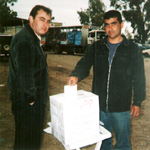
On February 17, the drivers went back to work. Elections for a permanent workers' committee were scheduled. Mr. S. Shilu'ah, Tempo's national workforce chief, tried to convince the workers and WAC to postpone the voting - but to no avail. Early in the morning of Tuesday March 7th, in front of the plant's gate, for the first time in the history of Tempo's northern branch, 59 workers cast their ballots.
Tempo enters the Global Market
On September 9, 1999, the Dutch company announced it had bought a stake in
Tempo. Explaining its future strategy in Israel, it wrote: "With this
transaction Heineken indirectly acquires a 17.8% stake in Tempo. The
consideration of the transaction is EURO 17 million. The acquisition
is a first step towards a further strengthening of the ties between
the two companies. Furthermore, the parties have concluded to separate
the beer activities from the Tempo company, which also produces and/or
sells annually 1.8 million hectoliters of soft drinks, fruit juices
and water. Subsequently Heineken will exchange its 35% stake in the
holding company into a direct stake of 50% in a newly formed brewing
company."
(For the full text, see: www.heineken.com.)
Heineken fails to mention in its press release that each of Tempo's three top managers receives a monthly salary of $28,000, whereas the average worker's salary amounts to a mere 2% of this figure. (Yediot Aharonot, March 15th 2000)
The long road toward building
a trade union 1. Some of the workers are organized in the Histadrut, which is not
willing to fight the company. The latter grants better salaries and
social benefits to certain workers, especially those in its Netanya
branch, while ignoring the others. WAC's endeavor to create a union for the drivers is still in
its beginnings. This will be a long, hard struggle. The Israeli labor
courts are reluctant to recognize alternative efforts to organize, which
would weaken the Histadrut's monopoly - although they know very well
how weak, often impotent, the Histadrut has become.
Tempo, a private company, is among the largest in Israel. It employs 1200 workers in various phases of production: beer in Netanya, soft drinks in Holon, plastic bottles in the development town of Yeroham. According to the company's profile, as published on the Internet (
The company was founded in 1954, as part of the government's attempt to create job opportunities for new Jewish immigrants. To this end, it received government subsidies toward opening the bottle factory in the distant desert-town of Yeroham. In recent years, however, the character of the company has changed. It has the concession for Pepsi Cola in Israel. It has exclusive rights to distribute the mineral water of a firm called Neviot, as well as the products of various juice companies. Above all, it has entered into partnership with the Dutch multinational, Heineken. This is the second largest beer company in the world, selling in 170 countries.
One reason why Heineken sees a potential for earnings at Tempo is the
low average wage, combined with the absence of union organization. The
future growth prospects of the Israeli company depend on its ability
to persuade the big boss in Holland to invest here. It is reasonable
to infer, therefore, that except for minute tactical concessions, Tempo
will fight against any attempt on the workers' part to gain a significant
improvement in salary. The Tempo workers, as well as WAC, face
two major difficulties in their struggle:
2. Except for a few professional organizations (doctors, teachers, journalists)
- and of course the Histadrut - no union in Israel is recognized as
a representative body. According to Israeli labor law, it is illegal
to strike except under the auspices of a recognized body. Until WAC
gains such recognition, Tempo workers will need support from the Histadrut
in order to declare a legal strike. Otherwise their employer can sue
them for damages.
Despite these difficulties, WAC has taken on this struggle. It
is organizing the Arab and Jewish workers together. WAC acts
in a spirit of international solidarity with all oppressed workers,
especially the Palestinians.
In May WAC undertook a campaign to explain how significant is
the struggle of the Tempo drivers, which has implications for the great
number of unorganized workers in Israel's food companies. At the foundation
of this campaign, we are attempting to show how important it is to establish
a militant trade union, in which Jewish and Arab workers, standing together,
will give expression to the new spirit that is now inspiring them.
We ask food-workers' unions all over the world, including Heineken
workers, to support our fight and make contact with us. Please e-mail
WAC at [email protected].